
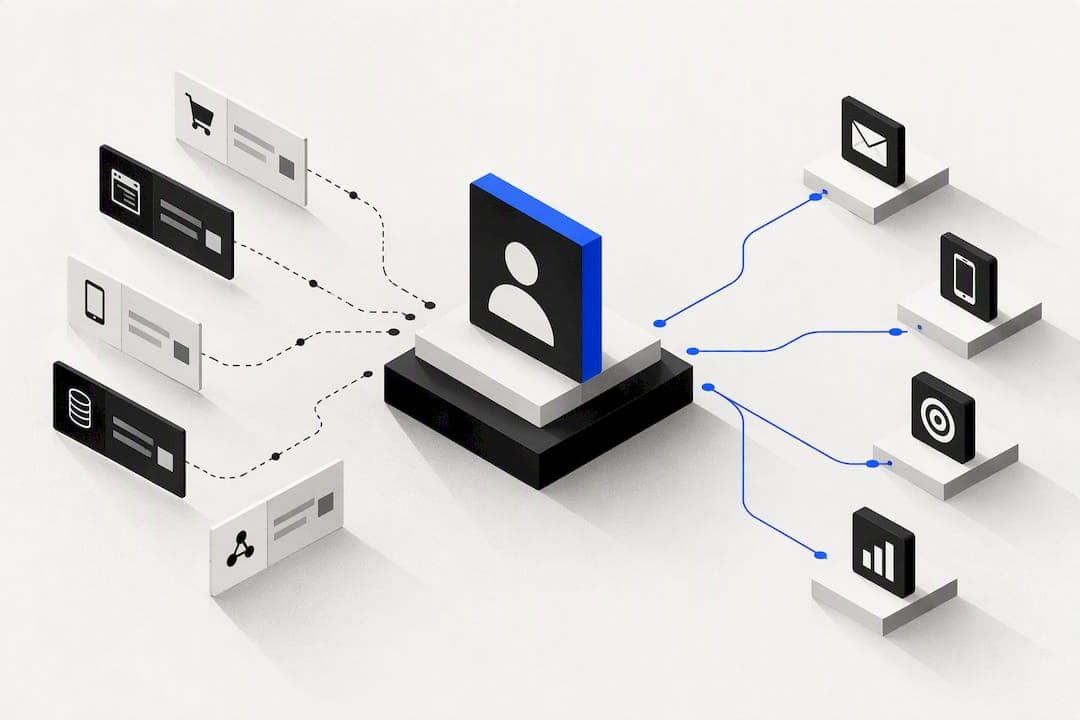
A single customer view is one up to date record that holds everything a business knows about a customer, built so marketing, service and finance teams all work from the same facts. Get it right and you can personalise messages, measure what actually works and switch on automated journeys with confidence. Get it wrong and you are guessing, with identity resolution gaps and consent problems sitting underneath every number you report.
TL;DR:
- For EEA advertisers, Google blocks Customer Match uploads without explicit consent signals, so pass each contact’s current permission to every activation endpoint.
- Start with two or three high value sources for one activation goal, and route uncertain identity matches to human review rather than merging automatically.
- Track match rate, merge precision, activation time, and revenue per engaged user; assign each measure an owner and report monthly across marketing and data teams.
- Avoid point to point integrations that multiply maintenance; use a shared identity model while keeping different clients’ or business units’ records separate.
Table of Contents
- What is a single customer view (SCV)?
- Why SCV matters: benefits and use cases
- Privacy, consent and governance for SCV
- Common challenges and pragmatic fixes
- Measuring SCV success: KPIs and activation metrics
- Where SCV impact shows up beyond marketing
- Integration strategies for connecting disparate business systems
- Paolo's perspective: practical priorities for teams building an SCV
- How OK Technology can help create and activate an SCV
- FAQ
- Sources
What is a single customer view (SCV)?
A single customer view, often called a Customer 360 or golden record, is the result of pulling together scattered pieces of customer data into one coherent profile. A canonical summary describes it as an aggregated, consistent and holistic representation of the data an organisation holds about its customers, drawn from CRM records, purchase history, support tickets and web behaviour, among other sources, per Wikipedia.
That said, "single" does not have to mean one rigid, all-purpose record. Some practitioners argue a single monolithic customer file is neither natural nor always useful. The more workable goal is consistent, role-specific views that all draw from the same underlying canonical data, so a finance dashboard and a marketing segment never disagree about who a customer is or what they have bought, per Wikipedia.
Technically, this canonical data usually lives in a data warehouse, a customer data platform or a master data store, with the identity graph sitting behind it to keep every system pointing at the same person.
Why SCV matters: benefits and use cases
The business case for a single customer view is straightforward: better personalisation, cleaner attribution, fewer wasted marketing sends and faster operational decisions. A unified profile lets a retention team spot a lapsing customer before they churn, lets a fraud team flag a mismatched identity across channels, and lets a marketer stop sending the same offer to someone who already bought.
A commissioned Total Economic Impact study found that customers using a governed data collaboration platform achieved significant ROI and substantial business benefits over three years, a signal of how much value well-governed customer data can unlock, according to LiveRamp's TEI findings. The study reflects one vendor's commissioned study rather than a universal benchmark, but it illustrates the scale of return that disciplined, consent-aware customer data work can produce.
Beyond marketing, customer service teams use SCV to avoid repeat questions across channels, and finance teams use it to reconcile who actually paid what, which matters as much as the campaign use case most guides focus on.
Privacy, consent and governance for SCV
An SCV is only as trustworthy as the consent behind it. Identity resolution has to be consent-aware from the start, and every activation endpoint, from an ad platform to an email tool, needs to receive the relevant consent signal alongside the customer data, not just the data on its own, per consent-aware processing research. For advertisers in the EEA specifically, Google requires explicit consent signals to be passed when uploading first-party data for features like Customer Match, and processing is blocked without it, according to Google's Ads support guidance.
- Map legal bases for every data source feeding the SCV before it goes live.
- Build a preference centre that captures consent at the point of collection, not after the fact.
- Enforce in real time, rejecting activation requests that lack a valid consent flag.
Centralised consent records tied to contact points work far better than legacy do-not-contact lists, because they support real-time enforcement across every channel at once, per Microsoft's compliance guidance. For a broader look at multinational obligations, Zero Through's guide to data protection laws is a useful reference. Our own guide to GDPR-ready CRM audits walks through the practical steps for getting consent records audit-ready.
Common challenges and pragmatic fixes
Most SCV projects stumble in the same three places. Each has a fix that does not require starting over.
- False merges: two different customers get wrongly combined into one record. Use conservative merge thresholds and route uncertain matches to human review rather than auto-merging, a practice supported by practitioner guidance on hybrid identity resolution, per this identity resolution research.
- Data quality and pipeline debt: too many low-value sources get prioritised early, stalling the project. Start with the two or three sources that unlock a clear activation use case, then expand.
- Team misalignment: marketing, data and IT disagree on what the canonical identifier even means. Set up a small cross-functional steering group that owns the identifier's definition and governance.
Measuring SCV success: KPIs and activation metrics
Treat the SCV as a system you tune, not a one-off project. Track match rate (the share of records successfully linked to a canonical ID), merge precision (how often merges are correct), time-to-activation (how long it takes a resolved profile to reach a live campaign), and revenue per engaged user.
- Run A/B tests comparing personalised, SCV-driven campaigns against a control group to isolate real lift.
- Assign a named owner to each KPI, with a monthly reporting cadence shared across marketing and data teams.
When data teams spend most of their time on pipeline construction rather than activation, the easiest way to prove value is to prioritise one or two high-impact use cases first, such as a personalised win-back offer, which demonstrates ROI quickly and keeps stakeholders aligned, according to the identity resolution playbook.
Where SCV impact shows up beyond marketing
Marketing gets most of the attention in SCV conversations, but the same canonical record changes how finance and operations teams work too. A finance team reconciling payments across a CRM, an invoicing tool and a separate payment processor often spends hours matching names and emails that do not quite align. A unified profile removes that friction: one customer ID means an invoice, a payment record and a support ticket all point to the same entity without manual cross-checking.

Project management benefits in a quieter but equally practical way. When a project lead can see a client's full history, past deliverables, outstanding invoices, open support tickets, in one place, scheduling and resourcing decisions get easier because nothing is hidden in a different tool. Teams managing recurring client work, such as agencies or consultancies, tend to feel this most, since a single missed invoice or unresolved ticket can otherwise slip between systems unnoticed.
Fraud and risk teams also lean on the same canonical identity graph, using it to spot when the same person appears under slightly different details across channels, a pattern that is far harder to catch when customer records sit in five disconnected tools. None of these use cases need a separate system: they need the same golden record that marketing uses, just surfaced through a different lens for a different team.
Integration strategies for connecting disparate business systems
Most organisations do not start an SCV project with clean, centralised data. They start with a CRM in one place, invoicing in another, project tools in a third, and marketing automation somewhere else entirely, each with its own idea of who the customer is.
The practical fix is to integrate at the platform level rather than building point-to-point connections between every tool, which tends to multiply maintenance work every time one system changes. A platform that holds CRM, finance, project management and marketing automation under one identity model avoids a lot of that stitching work by design, because the canonical record is shared rather than synced. Modern warehouse-first architectures that reduce data movement between systems support the same goal from a different angle, favouring a central store with an activation layer on top rather than dozens of bilateral syncs, per AWS's composable CDP guidance.
For teams managing multiple business units or client accounts, multi-company data isolation matters too: the canonical identity model needs to keep one client's records separate from another's while still letting internal teams work from the same unified structure. Our guide to resolving identity within marketing automation covers a practical build sequence for teams starting this work from scratch.

Paolo's perspective: practical priorities for teams building an SCV
Build an SCV in stages, not in one long project. Pick one activation use case, measure it, then expand the identity graph outward. Governance should be automated wherever possible: manual consent checks and manual merge reviews do not scale past a few thousand records. The projects that stall are usually the ones that tried to unify everything before proving anything.
— Paolo
How OK Technology can help create and activate an SCV
We built a platform to address the problem of customer data scattered across CRM, finance, marketing and project tools, with no single record tying it together. Integrating these functions under one identity model can remove the manual reconciliation work that often delays SCV projects, and charging per action rather than per seat or tier lets users pay only for the leads, emails, invoices and campaigns they actually run.

A typical first project looks like connecting your existing CRM data, resolving duplicate contacts and launching one activation use case, such as a win-back campaign, within a few weeks.
- Consolidate CRM, finance and marketing data under one identity model.
- Pay only for the actions you run.
- Add business or technical consulting hourly if you need hands-on help building the pipeline.
See full pricing details or explore the developer APIs if you want to connect identity resolution directly into your existing stack. When you are ready to talk through a first project, book a call.
FAQ
What is a single customer view?
A single customer view is a unified, consistent profile that combines everything an organisation knows about a customer, drawn from CRM, transactions, support and web activity, into one canonical record, according to Wikipedia. It lets different teams work from the same facts instead of conflicting spreadsheets or siloed systems.
What is single view?
"Single view" is shorthand for the same concept as a single customer view: one aggregated, consistent representation of customer data rather than fragments spread across separate tools. It is sometimes used interchangeably with "Customer 360" or "golden record."
What does the acronym SCV stand for?
SCV stands for single customer view, the unified record that brings together a customer's data from every system a business uses. It is the term most commonly used in marketing, data and CRM contexts to describe this unification process.
How is a single customer view different from a CRM?
A CRM is typically one of several data sources, not the finished unified view itself. An SCV pulls data from the CRM alongside transactions, support tickets and web activity, then resolves it into one canonical identity that the CRM alone cannot provide.
How long does it take to build a basic SCV?
Timelines vary by data complexity, but prioritising one or two high-value data sources and a single activation use case tends to produce a working first version faster than attempting to unify every system at once, per the identity resolution playbook. Our guide to building marketing automation CRM workflows outlines a four to eight week build sequence for a first project.
Sources
Building an SCV starts with inventorying where customer data actually lives, then stitching those fragments into one identity.
- LiveRamp TEI study (Business Wire)
Stitching these together is identity resolution: matching deterministic identifiers such as email addresses or customer IDs where they exist, and falling back on probabilistic models that score the likelihood two records belong to the same person when no exact key is available. The result feeds a canonical ID held in an identity graph, which becomes the backbone every other system references. Identity resolution playbooks stress that without this stitching step, even basic computed traits, like total revenue per customer, cannot be calculated reliably, per the identity resolution playbook.
The pipeline itself typically runs through six stages: ingest data in batch or streaming form, normalise formats and fields, match records against known identifiers, resolve conflicts into a single canonical profile, enrich with third-party or behavioural context, and activate the finished profile into the tools that need it. Building this requires combining deterministic and probabilistic matching with a consistent schema across every source feeding the pipeline, according to IDC's analyst brief on purposeful data. Our piece on preventing graph collapse covers the risks of getting the identity graph wrong at this stage.
Pro Tip: Start identity resolution with your highest-confidence deterministic match, usually email or account ID, before layering in probabilistic matching for harder cases.