
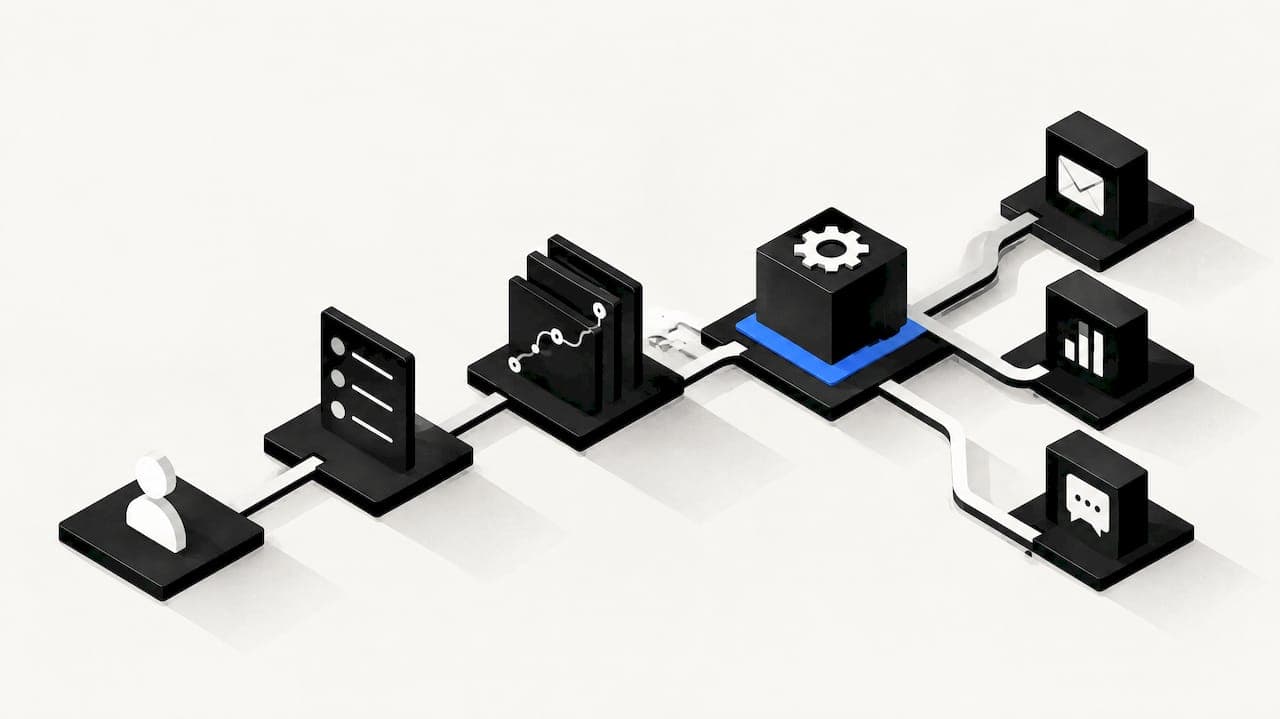
Customer journey automation uses data, triggers and rules to deliver personalised, timely messages across channels without manual effort from your team. It matters because it lets you run consistent, relevant interactions at scale, which tends to lift conversion and retention while freeing marketers from repetitive send-and-check work.
TL;DR:
- Customer journey automation relies on accurate identity resolution to prevent message duplication and ensure consistent, personalized customer experiences across channels.
- Mapping customer moments and setting clear exit conditions are crucial; skipping this can lead to scattered campaigns and eroded customer trust.
- Typical journeys include onboarding, cart abandonment, loyalty, and transactional flows, with onboarding providing the fastest measurable impact.
- Proper data preparation, testing, and rollback plans are essential to avoid misfires that could harm credibility and increase unsubscribe rates.
- A unified system integrating CRM, marketing automation, and billing reduces coordination overhead and enhances the effectiveness of automated journeys.
- ✓Marketing automation
- ✓CRM integration
- ✓Project management
- ✓Automated billing
Table of Contents
- What customer journey automation covers and core benefits
- How customer journey automation runs from map to execution
- Typical journey types and use-case templates to automate first
- Step-by-step implementation roadmap for teams
- Design trade-offs, risks and measurement
- Practical example: mapping the roadmap to OK Technology capabilities
- Author perspective: priorities and practical cautions for leaders
- A unified way to run customer journey automation
- FAQ
- Sources
What customer journey automation covers and core benefits
Customer journey automation rests on a few connected parts. Data sources feed the system with behaviour, purchase history and preferences. Identity resolution links a person's activity across devices and channels so a single profile drives every message. Triggers watch for specific actions or time windows. Decisioning logic decides what each person sees next, and orchestration pushes that decision out through email, SMS, push or in-app channels at the right moment, leveraging managed AI visibility to enhance adaptive personalisation.
The benefits show up quickly once these pieces work together:
- Less manual work, since campaigns run on rules instead of someone scheduling each send
- Sharper personalisation, because messages reflect actual behaviour rather than broad segments
- Faster time-to-value, as new journeys launch from templates rather than built from scratch each time
- Better retention, since timely nudges catch customers before they disengage
A welcome series triggered the moment someone signs up, for instance, routinely outperforms a generic newsletter because it answers the exact question a new customer has at that exact moment. A cart-abandonment flow works the same way: it reaches someone while the intent is still fresh, not days later when the moment has passed.
How customer journey automation runs from map to execution
A working system starts with a map, not a tool. You plot the moments that matter: sign-up, first purchase, renewal, support contact, and you decide which customers are eligible for which journey. Skipping this step is the most common reason automated programmes feel scattered rather than deliberate.
From there, the build follows a consistent sequence:
- Map the customer moments worth automating and set eligibility rules for who enters each journey
- Design triggers, whether behavioural (clicked a link), time-based (30 days since last order) or threshold-based (spend crosses a tier)
- Build the decision logic that determines message content, offer and channel for each trigger
- Unify identity and data sources so a customer's profile stays consistent whether they arrive by email, app or web
- Orchestrate delivery: prioritise which message wins when two journeys qualify at once, deduplicate sends, control timing and throttle frequency so no one gets flooded
- Set exit conditions and guardrails so people leave a journey once they convert, unsubscribe or go quiet
Orchestration is where most programmes lose control. If a customer qualifies for a win-back offer and a loyalty reward on the same day, the system needs a clear priority rule rather than sending both and confusing the message. Throttling matters just as much: a cap on daily or weekly touches per customer keeps the experience from feeling like pursuit rather than help.
Exit conditions deserve the same attention as entry triggers. A journey without a defined exit keeps messaging someone long after the moment has passed, which damages trust and inflates unsubscribe rates. Build the "stop" logic at the same time as the "start" logic, not as an afterthought.

Pro Tip: Build your exit rules before your entry triggers. If you can't describe when someone should leave a journey, you're not ready to automate it.
Identity resolution underpins all of this. Without a single view of the customer, triggers fire on partial information, decisioning logic works from stale data, and orchestration cannot deduplicate properly across channels. Get this layer right first.
Typical journey types and use-case templates to automate first
Some journeys deliver value faster than others because the trigger is obvious and the payoff is measurable. These are the templates most teams automate first:
- Onboarding and welcome: triggered at sign-up, running over the early days, measured against an activation metric such as first key action completed
- Cart abandonment and re-engagement: triggered by an incomplete checkout or a lapse in activity, often paired with a modest incentive to restore momentum
- Lifecycle, loyalty and VIP: triggered by spend thresholds or tenure, segmented so high-value customers receive preservation-focused treatment rather than generic promotions
- Transactional and service journeys: triggered by an order, delivery update or support ticket, focused on clear status notifications and a clean handoff to a human agent when needed
Onboarding tends to show the fastest measurable shift, since new customers are actively looking for guidance and a well-timed sequence directly raises activation rates. Cart abandonment flows are judged on recovered revenue per send, so keep the incentive proportional to margin. VIP and loyalty journeys are less about volume and more about protecting lifetime value: a single well-timed gesture to a top customer often matters more than a dozen generic touches. Transactional journeys carry the lowest personalisation intensity but the highest expectation of reliability. Customers tolerate a plain delivery notification; they do not tolerate one that arrives late or contains wrong information.
Step-by-step implementation roadmap for teams
Before any flow gets built, set the objective it serves. A journey without a measurable goal, such as activation rate, repeat purchase rate or reduced time-to-first-value, cannot be judged as working or not. Decide the metric first, then build towards it.
- Define objectives and the success metric for each journey before any build work starts
- Map personas and touchpoints, then rank candidate journeys by expected impact on revenue or retention
- Prepare the data: resolve identity across channels, confirm consent status for every contact, standardise field formats and clean out duplicate or stale records
- Build the flow in a test environment first, including message templates, trigger logic and a rollback plan if something misfires
- Launch with a holdout group, measure against the baseline, and iterate on a fixed cadence rather than constant ad-hoc tweaks
Data preparation is the step teams most often underestimate. A journey with excellent trigger logic still fails if half the contact records lack a valid consent flag or if a customer's email and app activity sit in two unreconciled profiles. Build this layer properly before adding more journeys, not after.
Testing deserves the same rigour as the build itself:
- Run A/B tests on subject lines, timing and offer value, one variable at a time
- Keep a holdout group outside every major journey so you have a clean baseline to measure lift against
- Instrument every step so you can see where customers drop out, not just whether they converted
- Review results on a fixed cadence, weekly for high-volume journeys, monthly for lower-volume ones, rather than reacting to single days of data
A rollback plan is not optional. If a trigger misfires and sends the wrong message to thousands of contacts, the ability to pause the journey within minutes matters more than almost any other feature in the build. Treat this as a launch requirement, not a nice-to-have.
Design trade-offs, risks and measurement
Two decisions shape every personalised journey: scope and intensity. Scope is which stages and touchpoints you choose to personalise; intensity is how strongly you personalise each one. Research from the University of Stuttgart frames these as separate decisions, each guided by contingency factors such as customer preferences, consent and the operational cost of sustaining the personalisation. The same research found that technology-savvy, privacy-tolerant customers accept higher intensity, while task-oriented or privacy-sensitive customers prefer a lighter touch, so a single intensity setting rarely suits an entire base.
A study of 775 omnichannel customers identified four design dimensions, thematic cohesion, consistency, context sensitivity and connectivity of touchpoints, that meaningfully improve customer experience and encourage customers to engage more actively with the brand. Thematic cohesion in particular, keeping a recognisable brand motif across every touchpoint, was linked to stronger value co-creation, meaning customers who experience a coherent journey are more likely to contribute feedback, referrals and repeat engagement.
Common pitfalls follow directly from ignoring these dimensions:
- Overpersonalisation, where intensity exceeds what the customer base finds acceptable, erodes trust rather than building it
- Poor data hygiene produces triggers that fire on outdated or duplicate records, undermining the whole system's credibility
- Inconsistent messaging across channels breaks the cohesion that research ties to better experience outcomes
For measurement, track activation rate, conversion rate, retention, any uplift in customer lifetime value, and error or failure rates in the automation itself, alongside a clear test design using holdout groups rather than before-and-after comparisons alone.
Practical example: mapping the roadmap to OK Technology capabilities
The roadmap above assumes a working identity layer, consistent data and a way to orchestrate messages across channels without juggling five separate tools. We built our platform to consolidate CRM, marketing automation, billing and document workflows into one system so the steps above do not depend on stitching together disconnected software.
In practice, this looks like:
- CRM leads and campaign sends tracked individually, so you see the cost of each journey rather than an opaque monthly subscription
- Industry and workflow selection built into the platform setup, so onboarding and lifecycle journeys can start from a relevant template rather than a blank canvas
- Multi-company isolation and white-label subdomains for managing several brands or client accounts from one system
Consolidating this way tends to cut the coordination overhead that comes from running separate CRM, email and billing tools, since data moves through one system instead of three.
Author perspective: priorities and practical cautions for leaders
If we had to pick one place to start, it would be the journeys tied directly to revenue or retention, not the ones that look impressive in a demo. Run a small number of measurable experiments before expanding scope. Invest in identity resolution and consent handling before you increase personalisation intensity: a technically sophisticated journey built on messy data will underperform a simple one built on clean data every time. Scale once you have evidence, not before.
— Paolo
A unified way to run customer journey automation
Running journey automation well means your CRM, campaign tool and billing system all agree on who a customer is and what has already happened with them. Our platform brings CRM, marketing automation and billing into one system with a pay-per-action billing model, so you pay for the leads, sends and documents you actually use. That model suits teams who have outgrown a patchwork of disconnected tools and want one place to build, measure and adjust journeys.
If you want to see how the pay-per-action model applies to your own volume of campaign sends and CRM leads, our pricing page breaks down the cost per action, or you can look at the full platform overview to see how the pieces fit together before you start.
FAQ
What are the five stages of a customer journey?
Most frameworks describe five stages: awareness, consideration, purchase, retention and advocacy. Automated journeys typically map one or more flows to each stage, such as an onboarding sequence at purchase and a loyalty flow at retention.
What are the seven steps of the customer journey?
A seven-step version breaks the same path into finer detail, commonly awareness, consideration, decision, purchase, retention, advocacy and loyalty. The exact labels vary by source, so treat the number as a planning tool rather than a fixed standard.
What are examples of customer experience tools?
Customer experience tools typically include CRM systems for contact and history data, marketing automation platforms for triggered messaging, and analytics tools for tracking behaviour across touchpoints. Some platforms, including ours, combine several of these functions into one system billed per action rather than as separate subscriptions.
What is the best customer journey mapping tool?
There is no single best tool; the right choice depends on whether you need standalone mapping software or a platform that connects mapping directly to live automation and CRM data. Teams consolidating multiple tools often prefer a unified platform so the map informs real triggers rather than sitting as a static diagram.
How do scope and intensity affect journey design?
Scope determines which touchpoints you personalise, while intensity determines how strongly you personalise each one, and research from the University of Stuttgart ties the right balance to customer-specific factors such as privacy tolerance and consent. Getting this wrong in either direction, too little personalisation or too much, tends to reduce the engagement the journey was designed to build.