

It suits businesses whose costs or value scale with customer activity, particularly SaaS, cloud infrastructure and AI companies. This guide covers the pricing models, the finance risks, the migration steps and the tooling decisions that determine whether the switch pays off.
TL;DR:
- Usage-based billing requires precise metering, attribution, and buffering for late events to ensure accurate, scalable tracking at high volumes.
- Six main pricing models exist, with graduated pricing offering the best rewards for scale, while prepaid credits are preferred for volatile AI tokens.
- Revenue risks include unpredictability from customer behavior, bill shock, and support overload, mitigated through caps, alerts, and hybrid plans.
- Migration should start with new customers, validated metrics, pilot phases, and cohort-based rollout to reduce churn and support complexity.
- Implementing reliable technology involves building, open-source solutions, or purpose-built platforms, with an emphasis on integration, fraud prevention, and compliance.
Table of Contents
- What is usage-based billing and how does it work?
- What pricing models does usage-based billing support?
- What are the financial benefits and risks of usage billing?
- How do you migrate to a usage-based billing model?
- What technology do you need to run usage-based billing?
- How does usage-based billing affect revenue recognition?
- How does Oktechnology apply pay-per-action billing?
- How do you detect and prevent fraud in usage-based billing?
- What are the regulatory and compliance considerations?
- Author perspective and strategic takeaways
- Get pay-per-action billing without the tool sprawl
- Sources
- FAQ
What is usage-based billing and how does it work?
Usage-based billing works through three connected stages: metering, rating, and invoicing. Metering captures what a customer actually consumed, tracking a value metric like API calls, AI tokens processed, agent actions completed, or gigabytes stored. Rating applies your pricing logic to that raw consumption data, converting "4,200 API calls" into a monetary figure. Invoicing then presents that figure to the customer, ideally with enough detail that they understand exactly why they owe what they owe.
Metering sounds simple until you try to do it at scale. Attribution gets messy when usage spans multiple team members or sub-accounts under one contract. Deduplication matters because a retried API call or a webhook fired twice can double-count consumption if your pipeline lacks idempotency checks. Late events, usage that arrives in your system hours or days after it happened, cause invoices to close before all the data has landed, which is why most billing platforms and open-source metering projects build in buffer windows for late events before finalising a bill.
Rating mechanics vary from flat per-unit rates to sliding scales that change with volume. The main components finance teams need to control:
- Metering accuracy: correct attribution to the right customer, contract and billing period.
- Rate card governance: one centralised source of truth for prices, not spreadsheets scattered across sales and finance.
- Invoice cadence: monthly is standard, but high-usage enterprise accounts sometimes need weekly or real-time visibility.
- Dispute handling: a documented process for when a customer challenges a usage figure, backed by raw event logs.
What pricing models does usage-based billing support?
Six pricing structures cover most usage-based billing deployments, and the right one depends on how predictable your customers need their bills to be versus how closely you want price to track cost.
- Per-unit flat pricing charges the same rate for every unit consumed, no matter the volume. Simple to explain, but it doesn't reward high-volume customers.
- Volume-tiered pricing applies one rate to the entire quantity once a customer crosses a threshold, retroactively discounting everything in that tier.
- Graduated pricing charges different rates for different slices of usage. The first 10,000 units at one rate, the next 40,000 at a lower rate, and so on.
- Prepaid credits let customers buy a bucket of usage upfront, common in AI products where "tokens" or "credits" abstract away the underlying compute cost.
- Outcome-based pricing charges for a completed result rather than raw consumption. For instance per resolved support ticket rather than per API call.
- Hybrid pricing combines a base subscription with usage overage, giving customers a predictable floor and vendors a way to capture upside.
Developer tools often favour graduated pricing because it rewards scale without punishing small integrations. AI APIs lean on prepaid credits because token costs are volatile and hard for customers to estimate in advance. Enterprise SaaS contracts frequently land on hybrids, pairing a committed base fee with metered overage.
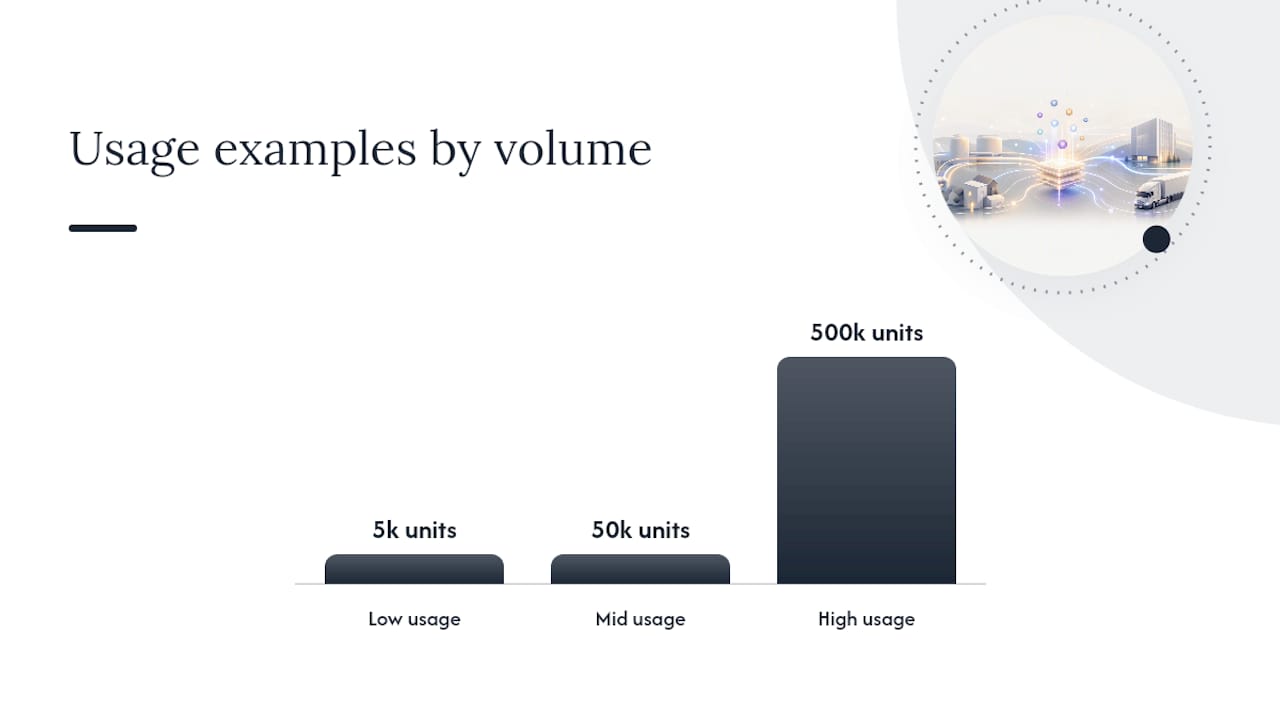
Consider three customers on an identical graduated rate card: a low-usage account processing 5,000 units pays close to the base rate; a mid-usage account at 50,000 units sees its average cost per unit drop as it crosses tier thresholds; a high-usage account at 500,000 units pays a fraction of the entry-level per-unit price, which is exactly the incentive that drives expansion. Adoption of this kind of consumption pricing has moved fast: SaaS companies using usage-based pricing grew from 27% to 46% between 2018 and 2022.
What are the financial benefits and risks of usage billing?
The upside is straightforward: customers pay in proportion to the value they receive, which lowers the barrier to adoption and makes expansion revenue almost automatic as usage grows. A customer who doubles their consumption doubles their bill without a renegotiation, a sales call, or a contract amendment. That alignment also improves conversion for trial users, since nobody has to guess which tier fits before they've used the product.
The risk sits on the other side of that same coin. Revenue becomes harder to forecast when it depends on customer behaviour rather than a fixed subscription count. A seasonal dip in customer activity shows up directly in your top line. Customers face their own version of the problem: unexpected usage spikes create "bill shock," a jarring invoice that arrives with no warning, and that single bad experience can outweigh months of fair pricing. It also tends to push more volume onto support teams, who field the "why is my bill higher this month" tickets that flat pricing never generated.
Mitigations are well established and worth building in from day one:
- Spending caps that stop billing (or send a hard alert) once a customer crosses a defined threshold.
- Hybrid subscriptions that keep a predictable base fee and only meter the overage, a mitigation finance teams commonly adopt to balance predictability against value alignment.
- Committed-use discounts that reward customers who commit to a usage floor with a lower effective rate, improving your revenue predictability in return.
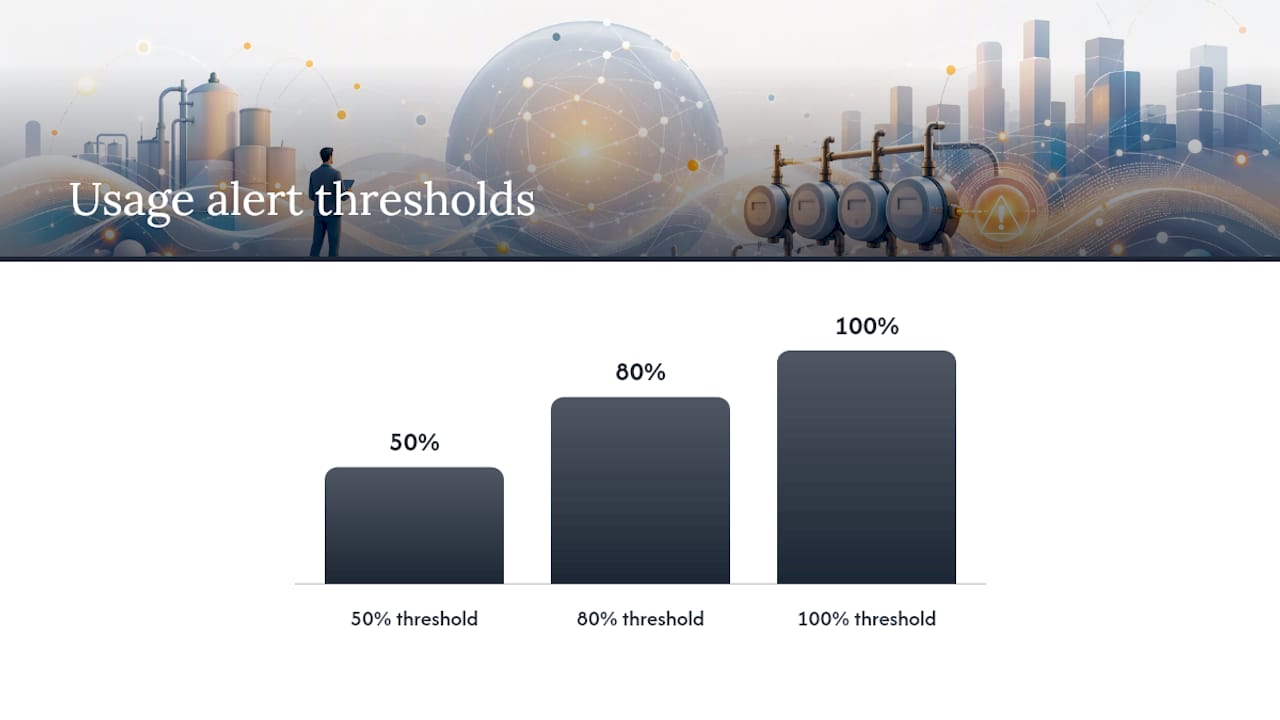
- Usage alerts sent at 50%, 80% and 100% of a customer's typical spend, so nobody is surprised by the final invoice.
Customers need time to adjust behaviour or budget before a bill lands, not a warning that arrives alongside the charge itself.*
How do you migrate to a usage-based billing model?
A staged rollout beats a company-wide switch every time. Migrations that succeed tend to follow the same sequence, starting with new customers and only later touching existing accounts.
- Choose and validate your value metric using historical usage data. Run it against real customer accounts before you commit. Does the metric correlate with the value customers actually get, and can they predict it themselves?
- Design the packaging around that metric: how much free allowance, what the base fee covers, where caps sit, and what committed-use discount tiers look like.
- Pilot with new signups first, leaving existing customers on legacy plans for a transition period. This is the approach that reduces support tickets and churn compared with forcing a mandatory switch on day one.
- Collect billing estimates and feedback from pilot customers before the model goes wide. Their confusion points are your future support tickets.
- Migrate existing customers in cohorts, starting with low-risk, high-trust accounts before touching your largest or most sensitive contracts.
Alongside the customer-facing rollout, several operational tasks need to happen in parallel:
- Write a formal metering specification that defines exactly what counts as one billable unit.
- Build a reconciliation process that matches invoiced totals back to raw ingested events, so disputes have an audit trail.
- Set a documented dispute process before you need it, not after the first angry email.
- Add buffer windows for late-arriving events so invoices don't close before all the usage has landed.
Communication carries as much weight as the technical work. Give customers concrete worked examples before launch, put a usage estimator on your pricing page so they can model their own costs, and send staged reminders (not just a single email) in the run-up to any mandatory migration date.
What technology do you need to run usage-based billing?
Metering infrastructure has to handle three things reliably: event ingestion at whatever scale your product produces, deduplication so a retried request doesn't get billed twice, and attribution so every event lands against the correct customer and contract. Idempotency keys, a unique identifier attached to each event, are the standard mechanism for catching duplicates before they hit an invoice.
Scale and latency become real engineering problems once a product generates millions of usage events a day. A metering pipeline built for a few thousand events a month often falls over when usage grows tenfold, and rebuilding it under pressure is worse than planning for it early.
Three broad paths exist for the underlying infrastructure:
- Build your own metering and rating pipeline in house, which gives full control but demands ongoing engineering investment that often gets underestimated once pricing models start changing.
- Open-source metering projects, such as OpenMeter, which provide ingestion, deduplication and billing primitives without starting from a blank page.
- Purpose-built monetisation platforms, which handle multidimensional pricing and faster launches of new pricing models with far less engineering effort per change.
Whichever path you choose, integrations matter as much as the core metering engine. Your billing system needs to talk to CPQ tools for quoting, CRM for account context, ERP and revenue recognition systems for the finance close, and payment gateways for actually collecting the money.
How does usage-based billing affect revenue recognition?
Usage revenue is recognised as the customer consumes the service, which is the core principle behind ASC 606 and IFRS 15: revenue is booked when (or as) a performance obligation is satisfied, not when cash arrives or when the invoice is raised. For a pure usage model, that generally lines up with the usage period itself. For hybrid plans, it gets more complicated.
A hybrid plan mixes a fixed subscription fee (typically recognised evenly over the contract term) with metered overage (recognised as consumed). That split means your finance team needs a clean way to separate invoiced amounts from recognised revenue, and to track deferred revenue for any prepaid credits customers haven't yet used.
Key practicalities to build into your close process:
- Keep a clear audit trail linking every invoice line back to the metering data that generated it.
- Track deferred revenue separately for prepaid credit balances that haven't been consumed.
- Reconcile invoiced totals against recognised revenue every period, not just at year end.
Pro Tip: Loop in your auditors before you launch a new pricing model, not after your first quarter close under it. Revenue recognition treatment for novel pricing structures is far easier to agree in advance than to defend retroactively.
How does Oktechnology apply pay-per-action billing?
The platform runs on a pay-per-action model: every billable action, such as sending an email, generating a CRM lead, creating an invoice, or storing a document, gets metered and charged individually rather than bundled into a flat tier. That mirrors the checklist above almost exactly: a defined value metric per action type, transparent rating, and invoicing tied directly to what happened.
The practical benefit for a buyer evaluating suppliers is fewer reconciliation headaches. When CRM, billing, document storage and campaign tools live in one platform with one metering layer, you're not stitching together usage reports from five vendors to understand your own spend. When you evaluate any usage-based vendor, ask how disputes get resolved, whether rate cards are centralised, and how late events get handled before an invoice closes.
How do you detect and prevent fraud in usage-based billing?
Fraud in metered billing takes a different shape than in flat-fee subscriptions, because the attack surface is the meter itself, not just the payment method. A bad actor who can manipulate reported usage, spoof events, replay legitimate requests, or exploit a metering gap, can either inflate a competitor's costs or shrink their own bill.
The most common vectors finance and engineering teams need to watch for are event replay attacks (resending a valid usage event to either inflate or, in shared-infrastructure cases, dilute a bill), account sharing that spreads one paid quota across many unbilled users, and synthetic usage designed to trigger free-tier credits or promotional thresholds repeatedly.
Practical defences map closely to the metering discipline covered earlier. Idempotency keys that block duplicate events also block a large share of replay-based fraud by design. Anomaly detection on usage patterns, flagging a sudden 50x spike from one account, catches both genuine incidents and deliberate abuse before they reach an invoice. Rate limiting at the API layer stops brute-force attempts to generate billable events artificially. Reconciliation reports that compare raw event logs against invoiced totals surface discrepancies that a purely automated pipeline might miss.
The finance-specific safeguard worth adding is a manual review threshold: any account whose usage jumps beyond a defined percentage in a single billing period gets flagged for a human check before the invoice goes out automatically. That single control catches both fraud and honest metering bugs, which matters because the two are often indistinguishable until someone looks.
What are the regulatory and compliance considerations?
Usage-based billing sits inside the same broader compliance framework as any other invoicing model, but a few areas need specific attention because consumption pricing generates far more granular data and more frequent billing events.
Tax treatment can vary by jurisdiction and by what's being metered. Digital services taxes, VAT and sales tax rules often hinge on where the customer is located and what category of service they're consuming, and usage-based invoicing means tax calculations run far more frequently than with a single monthly subscription charge. Get your tax engine integrated with your metering pipeline rather than treating it as an afterthought at invoice time.
Data privacy rules matter more here than in flat-fee billing because usage metering often captures behavioural data, what a customer did, how often, at what time, that can qualify as personal data under regulations like the UK GDPR or the EU's GDPR. Retention policies for raw usage events need to balance the reconciliation and audit-trail needs covered earlier against the principle of not holding data longer than necessary.
Contract terms need to state clearly what happens in a billing dispute, what evidence the customer is entitled to see, and what the escalation path looks like. Enterprise buyers increasingly ask for this in writing before they'll sign, particularly if a previous vendor gave them an unpleasant billing surprise. None of this replaces proper legal advice for your specific jurisdiction and industry, but building the audit trail and dispute process described earlier puts you in a defensible position from the start.
Author perspective and strategic takeaways
Three things separate usage-based billing that works from usage-based billing that quietly bleeds customers: a value metric people can predict without a spreadsheet, a pilot cohort before any mandatory migration, and hard spending caps from day one, not added after the first support escalation. Most failures I'd flag aren't pricing failures. They're metering failures dressed up as pricing complaints, a dispute that traces back to a deduplication bug nobody caught. Skip usage-based billing entirely if your product's consumption pattern is genuinely unpredictable to the customer themselves. If they can't estimate their own usage, no amount of dashboard polish will stop the bill shock.
— Paolo
Get pay-per-action billing without the tool sprawl
The platform charges per action rather than per seat, tier, or unused bundles. Every email sent, lead generated, invoice created or document stored gets metered and billed individually, which means users are not paying for unused capacity across multiple subscriptions.
That matters most for businesses that have outgrown a patchwork of separate tools for CRM, billing, marketing and finance, where nobody has a single clean view of total spend. Consolidating those actions into one metered ledger removes the reconciliation work this guide spent several sections describing, because there's only one system generating the invoice in the first place. Check the pricing page for the full list of metered actions and rates, or get in touch to talk through what a pay-per-action setup would look like for your own usage patterns.
Sources
For technical implementation detail, see OpenMeter's metering primitives and Stripe's usage-based billing documentation. For migration planning, see Stripe's usage-based pricing strategy guide.
- Usage-based billing explained: How it works and how to optimize its benefits — Stripe
- openmeter · GitHub
- Usage-based billing software for AI | Metronome, a Stripe product
- Usage-Based Billing Platform for AI & SaaS | Chargebee
FAQ
What is usage-based billing?
Usage-based billing is a pricing model where customers pay based on how much of a service they actually consume, rather than a fixed recurring fee. Common value metrics include API calls, storage volume, AI tokens processed or completed transactions, and the model has grown from 27% to 46% adoption among SaaS companies between 2018 and 2022.
How does usage-based billing work?
It runs through three stages: metering captures raw consumption data, rating applies your pricing logic to convert that into a monetary figure, and invoicing presents the final charge to the customer. Getting metering right, particularly deduplication and attribution, is what determines whether the other two stages produce an accurate bill.
Can I bill customers based on usage?
Yes, and most SaaS, cloud and AI businesses can implement it either by building metering infrastructure in house, adopting an open-source project like OpenMeter, or using a purpose-built monetisation platform. Oktechnology applies this directly through its pay-per-action model, metering and billing individual actions like emails, leads and invoices rather than charging flat tiers, with current rates listed on its pricing page.
What does "usage-based" mean?
"Usage-based" means the price a customer pays scales directly with how much of a product or service they consume, rather than being fixed regardless of activity. It's the pricing logic behind pay-per-use billing, metered billing and consumption-based SaaS pricing, all describing the same underlying mechanism.