
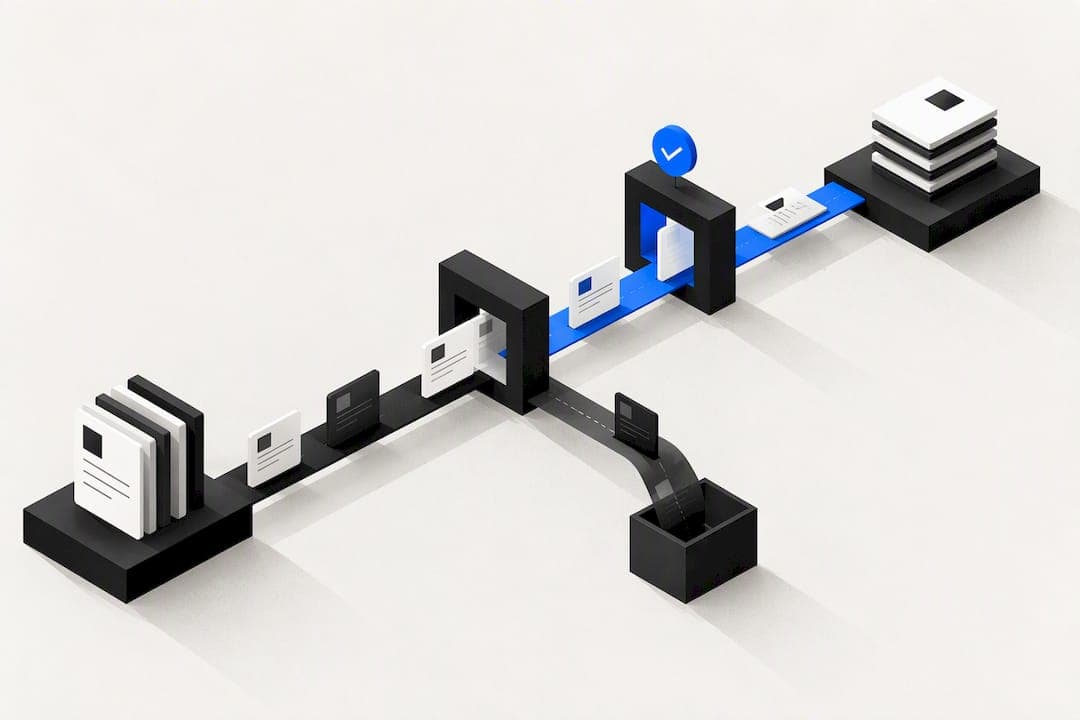
A project intake process is the standard route every new request travels before it becomes a project: capture, triage, assessment and approval. Standardise the request form and enforce a single triage gate first. That one change gives you a prioritised, executable backlog instead of a pile of competing demands, and it works even before you add scoring models or full portfolio tools.
TL;DR:
- Implement a single triage gate with a standardised intake form to prioritize requests based on their strategic alignment and avoid bypassing stages.
- Use a clear five-stage workflow: discovery, triage, assessment, approval, and planning handover, with defined exit conditions at each step.
- Keep the initial intake form concise, under ten fields, focusing on essential data to improve submission rates and facilitate automation.
- Rely on scoring models for consistency, focusing on strategic fit, value, effort, and risk, rather than precise calculations or fixed schedules.
- Enforce "no form, no project" policy from the start and run a pilot period to foster adoption before full deployment, avoiding excessive approval layers and unlabeled tasks.
Table of Contents
- What a project intake process is and why it matters
- Signs your intake process is broken and what that costs
- Core components of a robust intake process
- Practical intake workflow: step by step
- How to prioritise: scoring, cut lines and reprioritisation
- Tools, templates and integration: what to automate
- Implementation tips, adoption tactics and common pitfalls
- How OK Technology maps onto intake process needs
- When to centralise intake and when to decentralise
- Get your intake process running with OK Technology
- FAQ
- Sources
What a project intake process is and why it matters
An intake process is not paperwork for its own sake. It is how requests get connected to strategy before anyone commits time or budget to them. Project portfolio management guidance frames this as doing the right projects at the right time, using governance to align work with objectives and ration limited resources rather than approving whatever lands first.
Three benefits follow directly from a working intake process:
- Alignment: every request is checked against strategic objectives before it gets resourced.
- Capacity control: you see demand against available hours instead of discovering overload mid-quarter.
- Visibility: sponsors and teams see what is queued, what is approved and what was rejected, and why.
Without this layer, prioritisation happens by whoever shouts loudest, and that is expensive to unwind later.
Signs your intake process is broken and what that costs
Most teams recognise a broken intake process once they look for it. Side-door requests arrive through chat messages and hallway conversations, skipping any form. Delivery teams run over capacity without anyone having checked utilisation first. Approvals happen after work has already started, turning sign-off into a formality rather than a gate.
Run this six-point check in about ten minutes:
- Can you name every active project without checking three different tools?
- Did any project start without a completed request form in the last month?
- Do you know your team's current utilisation percentage?
- Has a sponsor approved every project currently in flight?
- Can you trace reworked projects back to a missed assessment step?
- Is there a single place requesters go to submit new work?
Two or more "no" answers point to an intake process that is costing you more rework and more overtime than it should.
Core components of a robust intake process
A few concrete pieces make the difference between a process that works and one that gets bypassed within a month.
- A standardised intake form: fixed required fields plus conditional logic, so a marketing request and an IT infrastructure request trigger different follow-up questions.
- Clearly assigned roles: a requester who owns the idea, a triage owner who screens it, a resource reviewer who checks capacity, and a sponsor who holds final authority.
- Approval gates: fixed points where a request can be stopped, sent back or waved through, with named authority at each gate.
- Data mapping and automation: approved fields flow automatically into your project record, so nobody re-types the same information twice.
What is a business case? from the Association for Project Management frames the business case as a decision record reviewed at each gate, comparing alternatives including the option of doing nothing at all. That framing matters: a gate is not a checkpoint, it is a decision.
Pro Tip: Keep the intake form under ten fields for the first pass. You can always ask for more detail at the assessment stage, but a long form kills submission rates before you even get to prioritise anything.
Practical intake workflow: step by step
A workable intake workflow has five stages, and each one needs a clear exit condition before work moves on.
- Discovery: the requester captures the problem, desired outcome and rough timing, ideally with help from a triage owner who knows what good detail looks like.
- Triage: check the request against do-not-pass criteria, such as missing sponsor, no budget indication, or duplicate of existing work; reject or return incomplete requests here.
- Assessment: score the request, check it against current team capacity, and list dependencies on other active projects.
- Approval: the request passes through its gate, where named authority accepts, defers or declines it based on the business case.
- Planning handover: approved requests move to delivery with their form data intact, so planning starts from real information rather than a fresh conversation.
This sequence mirrors what the Smartsheet intake process guide describes: standardised forms and staged reviews that move an idea cleanly from submission to an approved project plan.
How to prioritise: scoring, cut lines and reprioritisation
Scoring models exist to create consistency, not mathematical precision. PMI's portfolio guidance treats scoring as a tool to reduce political decision-making, keeping the loudest stakeholder from overriding a strategy-led choice. Scoring is a consistency mechanism, not a truth generator, and treating it that way keeps debates focused on criteria rather than opinions.
A workable scoring model needs only a few components:
- Strategic alignment: does this support a named objective, or not?
- Value: what measurable benefit does it deliver?
- Effort: rough size, in ranges rather than precise hours.
- Risk: what could stop this from delivering as planned?
Score in bands (low, medium, high) rather than decimals: false precision invites arguments about 6.2 versus 6.4 that add nothing. Draw a visible cut line based on real capacity, not optimism, and treat anything below it as deferred rather than quietly squeezed in. Re-run prioritisation whenever capacity shifts meaningfully, not on a fixed calendar.
Tools, templates and integration: what to automate
Choose intake tooling based on three things: whether it supports conditional fields, whether it can route requests automatically to the right reviewer, and whether it connects to the systems you already run through an API.
The integrations that matter most are your project and portfolio management system, your CRM, a capacity planner, and shared calendars, so requests, resourcing and scheduling stay in step without manual re-entry. Automate the easy wins first: auto-creating a project record on approval, sending notification emails at each gate, and validating required fields before submission.

A minimum viable intake form needs essential fields capturing requester, objective, business justification, timeline, effort estimate, sponsor, dependencies, and budget source. Anything beyond that can wait for the assessment stage.
Implementation tips, adoption tactics and common pitfalls
Getting people to actually use an intake process is harder than designing one. Springer's research on portfolio management capability found that introducing new portfolio practices depends on sensegiving: executive sponsors repeatedly explaining why the change matters until new routines become habit rather than a rule people resent. Adoption is a long process, not a launch date.
Enforce "no form, no project" from day one, but phase how strictly you apply it. A hard rule with no exceptions in week one tends to generate workarounds instead of compliance.
Pro Tip: Run a pilot for six to eight weeks with one team, track submission completeness and cycle time, then widen the rollout once the form and gates are proven.
Common pitfalls worth avoiding:
- Adding so many approval layers that small requests take longer than the work itself.
- Ignoring business-as-usual tasks, which then route around the process entirely.
- Rolling out the form without training anyone on why each field exists.
How OK Technology maps onto intake process needs
We built our platform to support workflows that integrate CRM, project management and billing into a unified system. Requests captured through the system map directly into project records without manual re-entry, and actions are billed individually so teams can track costs for each stage of intake in real time.
When to centralise intake and when to decentralise
Centralise intake when skills are scarce and prioritisation decisions carry real trade-offs. Decentralise, with a standardised form still enforced, when teams move fast and local judgement beats a central queue. Pilot whichever model matches your current bottleneck before committing to it for the whole organisation.
— Paolo
Get your intake process running with OK Technology
This platform allows teams to move intake data directly into live project records instead of retyping it across separate tools, helping to maintain process integrity.
- Projects, CRM leads and invoicing all draw from the same request data once it is approved.
- The platform uses a pay-per-action model that charges based on usage of leads, documents and invoices, avoiding tiered plans.
For intake processes that depend on specialist technical sign-off, our partner at NEXTmsp offers IT strategy and roadmapping support worth considering alongside your own gates. Check our pricing page to see exactly what each action costs before you commit.
FAQ
What are the 5 stages of a project?
Most frameworks describe initiation, planning, execution, monitoring and closure as the five stages, which follow on from a successful intake decision. Intake itself happens before initiation, acting as the gate that decides whether a request becomes a project at all.
What are the 7 steps of a project?
Definitions vary depending on the methodology used, but a common version expands the five stages into discovery, definition, planning, execution, monitoring, closure and review. The exact count matters less than having clear exit criteria between each step.
What is an intake process?
An intake process is the standard route a request takes from submission through triage, assessment and approval before it becomes an active project. The Smartsheet intake guide describes this as organising requests into discovery, assessment and planning phases using a standardised form and staged reviews.
What should be included in a project intake form?
A workable form captures the requester, objective, business justification, timeline, estimated effort, sponsor, dependencies and budget source. Conditional fields can add detail for specific request types without lengthening the form for everyone else.